
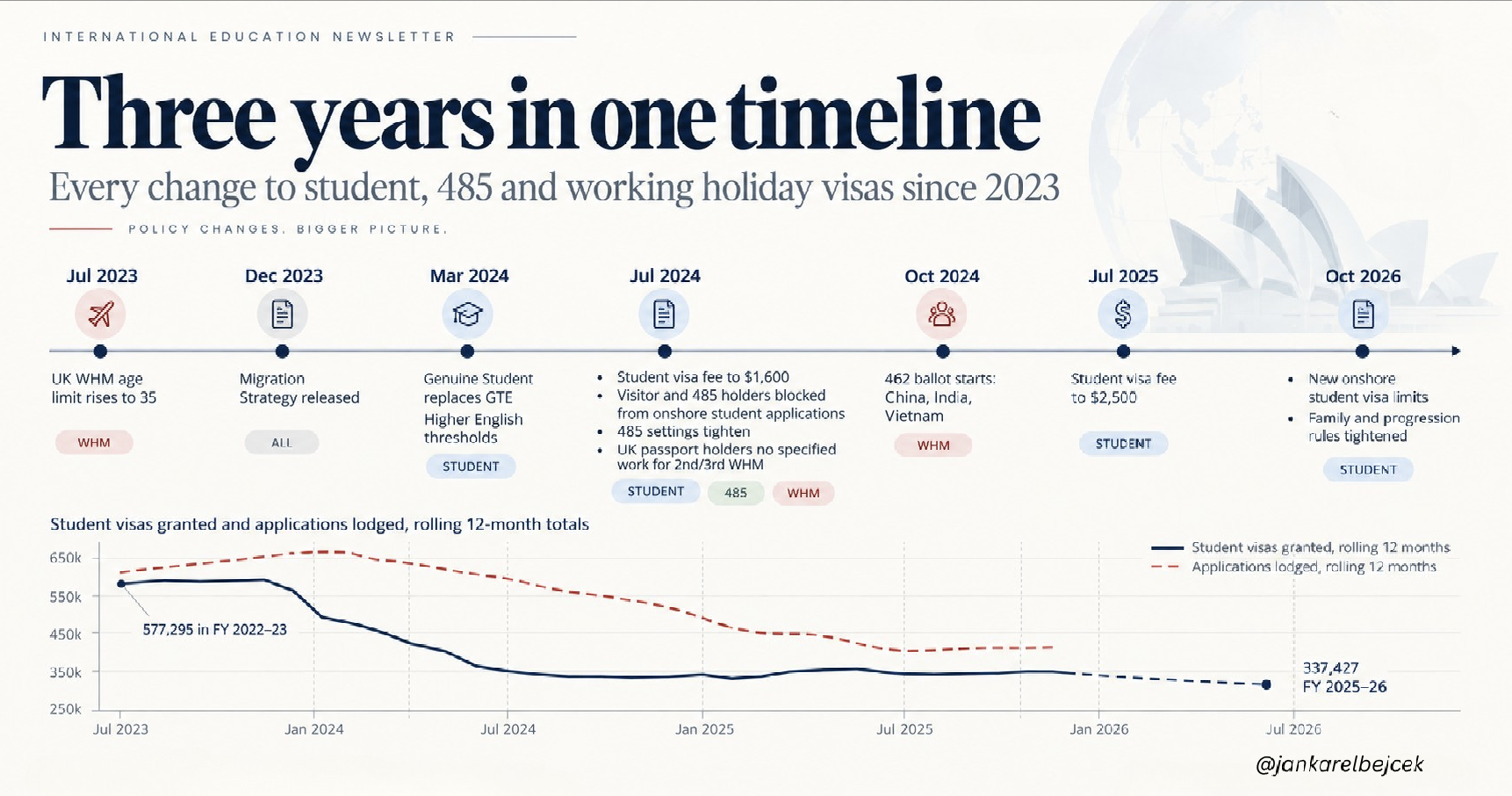
In July 2023 Australia added two years to post-study work rights. Twelve months later it took them away.
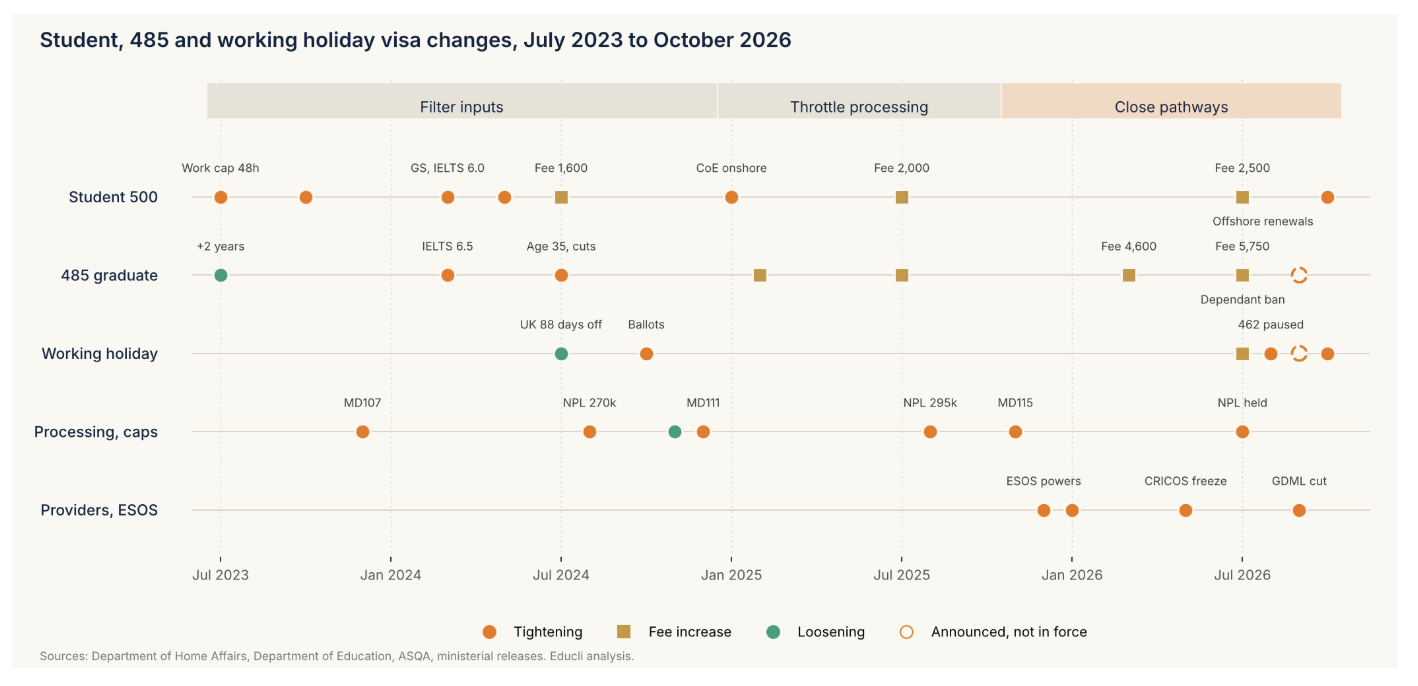
What followed was a sequence of fee rises, tougher tests, processing directions, provider powers and, from October 2026, the end of most onshore renewals and family members on new student visas.
This is the full list, in order, followed by what it means for the next 12 to 24 months.
The changes
2023
- 1 Jul 2023: two-year extension to the 485 for select shortage-area degrees.
- 1 Jul 2023: student work cap reintroduced at 48 hours per fortnight.
- Oct 2023: student savings requirement AUD 24,505.
- 11 Dec 2023: Migration Strategy released.
- 14 Dec 2023: Ministerial Direction 107.
2024
- 23 Mar 2024: Genuine Student requirement replaces GTE.
- 23 Mar 2024: IELTS 6.0 for the student visa, 6.5 for the 485.
- 10 May 2024: student savings requirement AUD 29,710.
- 1 Jul 2024: student visa fee AUD 710 to AUD 1,600.
- 1 Jul 2024: visitor and 485 holders barred from applying for a student visa onshore.
- 1 Jul 2024: 485 two-year extension removed.
- 1 Jul 2024: 485 maximum age 50 to 35; stays cut to 2 years for bachelor and coursework master’s, 3 years for research; Replacement stream closed.
- 1 Jul 2024: UK working holiday makers exempt from 88 days of regional work.
- Aug 2024: 2025 National Planning Level 270,000.
- 2024: working holiday ballots for China, India and Vietnam.
- Nov 2024: enrolment caps bill fails in the Senate.
- 19 Dec 2024: Ministerial Direction 111 replaces MD107.
2025
- 1 Jan 2025: onshore student applications require a CoE at lodgement.
- 1 Feb 2025: 485 fee AUD 1,945 to AUD 2,235.
- 1 Jul 2025: student visa fee AUD 1,600 to AUD 2,000.
- 1 Jul 2025: 485 fee AUD 2,235 to AUD 2,300.
- Aug 2025: 2026 National Planning Level 295,000.
- 14 Nov 2025: Ministerial Direction 115 replaces MD111.
- 5 Dec 2025: ESOS integrity amendments commence: course suspension and cancellation powers, registration suspension powers, two years of domestic delivery for new VET providers.
2026
- Jan 2026: agent commissions banned on onshore transfers.
- 1 Mar 2026: 485 fee AUD 2,300 to AUD 4,600.
- 19 May 2026: new CRICOS registrations and add-to-scope applications to ASQA suspended for 12 months.
- 1 Jul 2026: student visa fee AUD 2,000 to AUD 2,500.
- 1 Jul 2026: 485 fee AUD 4,600 to AUD 5,750.
- 1 Jul 2026: working holiday fee AUD 840 for a first visa, AUD 1,000 for a second or third.
- 3 Jul 2026: 2027 National Planning Level held at 295,000; TAFE exempt.
- Aug 2026: first-time 462 applications paused for 23 of 29 partner countries.
- 4 Sep 2026: Graduate Diploma of Management (Learning) cancelled for new international students, effective 5 Oct 2026.
- 17 Sep 2026: partners and children removed from most new student and 485 visas announced.
- 17 Sep 2026: second-year working holiday ballot capped at 45,000, third year at 5,000, announced.
- 2 Oct 2026: most student visa holders must apply offshore for a new student visa and be offshore at grant.
- 2 Oct 2026: new student visa applications generally cannot include partners or children.
- 2 Oct 2026: working holiday, 482, 457, 400, 407 and 408 holders barred from applying for a student visa onshore.
- 2 Oct 2026: no ART review for student visa refusals where the applicant was required to apply offshore.
What to expect in the next 12 to 24 months
1. The 485 rise and fall
The 485 is still growing. There were 225,901 Temporary Graduate visa holders in Australia at 31 December 2025, up 15.7 per cent in a year. 485 lodgements in July to December 2025 were up 87.8 per cent on the year before.
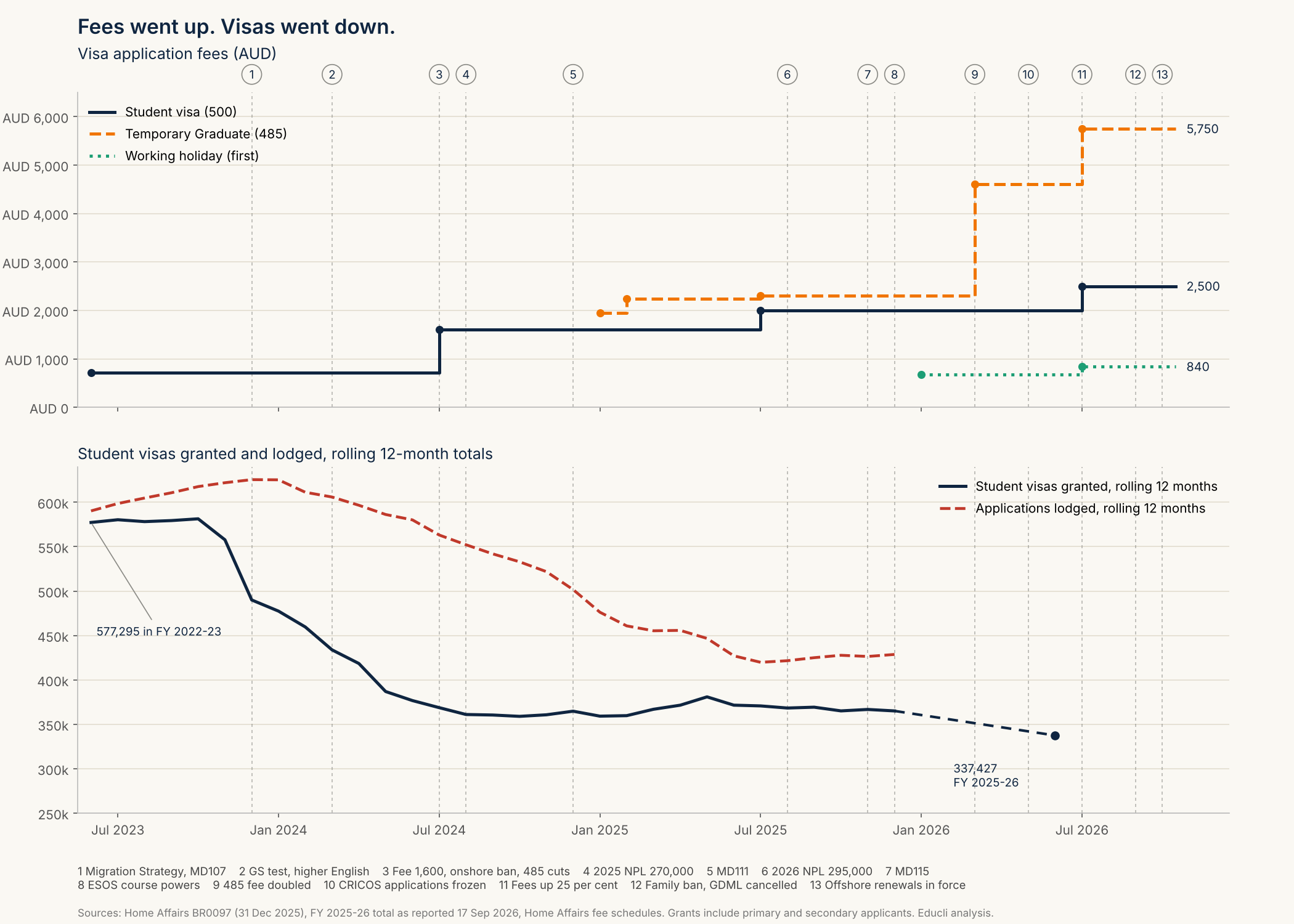
That growth is the tail of the 2022-23 intake. The cohorts behind it are smaller. Student visa grants have been around 365,000 a year since mid 2024, against 577,000 in FY 2022-23. Those smaller cohorts graduate through 2026 and 2027.
Cause: AUD 5,750 application fee, no family members and no onshore return to a student visa. Expect 485 grants to peak in FY 2025-26 or FY 2026-27 and decline from there.
2. Dependants removed
In FY 2025-26, 45,991 of 337,427 student visa grants went to secondary applicants. That is 13.6 per cent of the program.
Most of those grants stop. Pacific, ASEAN, PhD and government-funded students are exempt. Everyone else applies as a single applicant or must go elsewhere.
Expect student visa grants to fall by up to 40,000 a year from this measure alone, independent of demand. Expect the mix to shift towards younger, single applicants and the exempt nationalities. The same pressure is on the 485 once its dependant ban is legislated.
3. Refusals concentrate by country and sector
The offshore grant rate fell from 90.0 per cent to 83.8 per cent in the December quarter 2025, year on year. In offshore VET it fell from 60.2 per cent to 41.8 per cent. In offshore higher education it fell from 92.0 per cent to 85.8 per cent.
Demand is moving to the markets assessed hardest. In July to December 2025, lodgements rose 54.6 per cent from Nepal and 86.7 per cent from Bangladesh. Grants rose 40.5 per cent and 46.2 per cent. Lodgements from China fell 24.0 per cent.
Expect higher refusal rates for South Asian applicants and VET-linked applications. Most refused students forced offshore now have no tribunal review, so they reapply or leave the market.
4. Working holiday slows down
First-time 462 applications are paused for 23 of 29 partner countries. Second-year places drop from around 57,000 to a 45,000 ballot. Third-year places drop from around 31,000 to a 5,000 ballot.
Working holiday makers can no longer move onto an onshore student visa. Expect fewer working holiday makers by late 2027, longer processing, and a smaller onshore pipeline into ELICOS and VET. Regional employers lose the third-year workforce first.
The shift
For two years the government reduced temporary visa grants through fees, tougher tests and processing directions and indirectly managed who got in. From late 2025 it changed the pathways themselves.
In a knee-jerk reaction to political pressure, the government targeted private education pathways, working holiday makers and visitors to reduce net overseas migration. The long-term consequences will show in public higher education pathways, the local economy and Australia’s appeal as a destination.
The number to watch is not the planning level. Commencements will most likely stay well below it. The number to watch is how many students, graduates and working holiday makers are still in Australia in 2028.
#InternationalEducation #StudentVisa #485Visa #WorkingHolidayVisa #AustralianImmigration #MigrationPolicy #StudyInAustralia #HigherEducation
Sources: Department of Home Affairs, Student and Temporary Graduate visa program report (BR0097) at 31 December 2025; Department of Education; ASQA; Study Australia; ministerial media releases; Federal Register of Legislation (F2026L01347, F2026L01348, LIN 26/087). FY 2025-26 grant total as reported 17 September 2026.