
The national planning level for 2027 is the same as 2026: 295,000 new overseas students. On paper, nothing has changed.
Underneath, almost everything has. Since 2 October, students can no longer move freely between visas, courses or providers while onshore. Working holiday makers can no longer switch to study. A whole qualification has been removed from the market.
1. The first numbers are in
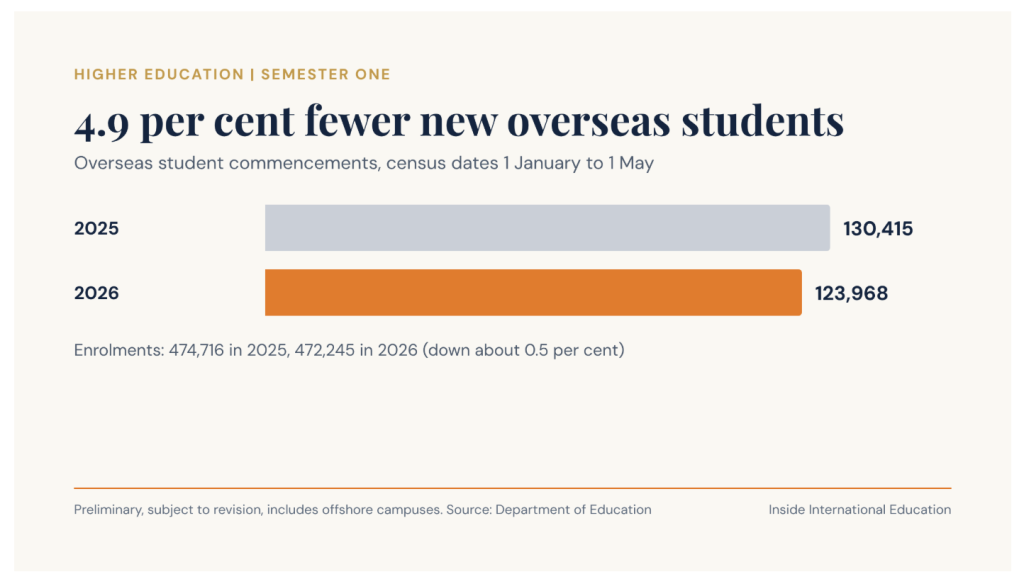
On 15 October the Department of Education released preliminary semester one figures for higher education, covering census dates from 1 January to 1 May.
- Overseas student commencements: 123,968, down from 130,415 at the same point in 2025. A fall of 4.9 per cent.
- Overseas student enrolments: 472,245, down from 474,716. A fall of about 0.5 per cent.
- The figures are preliminary, subject to revision, and include students at offshore campuses.
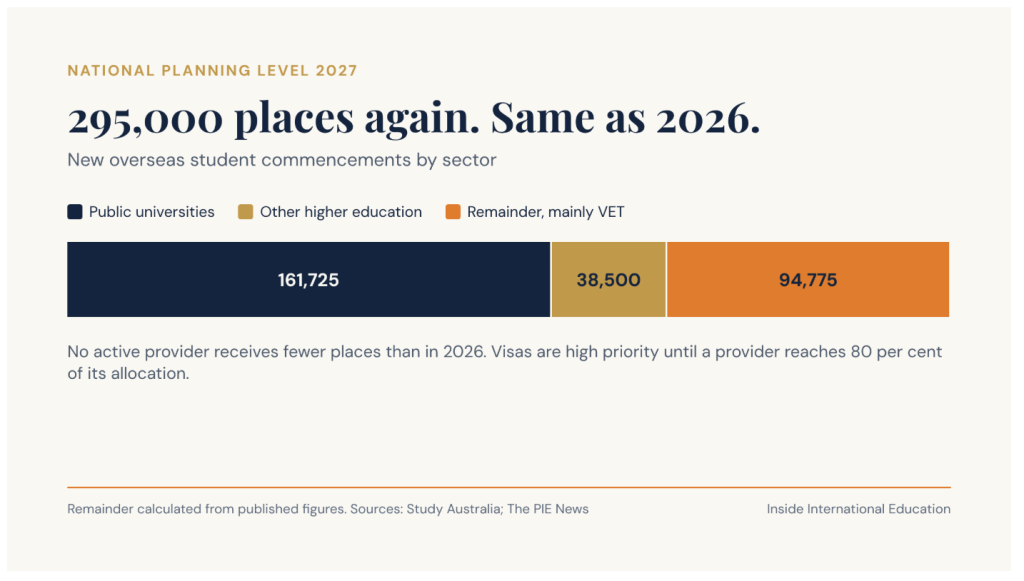
For 2027 the planning level stays at 295,000:
- Public universities: 161,725 places, unchanged from 2026.
- Other higher education providers: 38,500 places, recalculated with more weight on students recruited from offshore.
- VET: no provider below its 2026 allocation, and larger providers up around 3.5 per cent. Publicly funded TAFEs are exempt.
- Visa processing stays tied to allocations. Applications are high priority until a provider reaches 80 per cent of its allocation, then slow down.
What I am watching
Higher education is the end of the pipeline, not the start. English language and VET students feed it one to two years later. A five per cent fall in university commencements now says little about what the 2 October rules will do to 2027 and 2028. The feeder sectors will show it first.
2. Three weeks of the onshore rules
The student visa reforms have applied to applications made since 2 October 2026.
- Most student visa holders must apply for a further student visa from outside Australia. Exemptions cover PhD students, sponsored and scholarship students, school students and some students affected by provider default.
- Most other temporary visa holders, including working holiday makers, can no longer apply for a student visa onshore.
- Family members can be included only for PhD students, government scholarship holders, and students from ASEAN and Pacific Island nations. Subsequent entrant applications have gone.
The effect falls hardest on English language colleges. A student finishing an English course can no longer simply extend onshore into the next course. The students who want to stay are pushed toward courses with a higher qualification level, and the ones who cannot get there leave.
3. Transfers: twelve months, not six
A less noticed instrument commenced on the same day: the National Code Amendment (Overseas Student Transfers) Instrument 2026.
- From 2 October 2026 to 30 June 2027, students cannot transfer providers in the first 12 months of their principal course. The restriction was six months.
- It applies to current students, including those who had already completed between six and twelve months.
- Exceptions: the provider or course is no longer registered, a regulator sanction stops the student continuing, the releasing provider agrees and records the reason in PRISMS, or a government sponsor supports the move in writing.
- Receiving providers must not knowingly enrol a student during the restricted period unless an exception applies.
- From 1 July 2027 the period returns to six months. At the same time, students changing providers will need a new visa under a student transfer stream.
What it means
Combined with the limits on agent commissions for onshore transfers introduced earlier this year, the onshore transfer market is close to shut until mid-2027. Release decisions now sit with the original provider. Expect more release requests, more refusals and more complaints.
4. Graduate Diploma of Management (Learning) cancellation
On 4 September the Graduate Diploma of Management (Learning) was announced for deregistration from 5 October.
- At the announcement, 452 VET providers were registered to deliver it, with 41,033 active confirmed enrolments and 15,772 students studying.
- In the month before the deadline, more than 2,800 enrolments were added or brought forward. Numbers grew 18 per cent.
- Home Affairs sent the providers involved a please-explain.
Every closing door produces a rush. That is not a surprise, and it is not new. When a policy is announced a month before it starts, the market uses the month.
5. Working holiday makers: the quiet feeder
- Since early August, applications from 24 countries in the capped subclass 462 stream have been paused for 2026-27. Processing for uncapped countries has slowed since 1 July.
- On 17 September the Minister announced ballots for second and third-year stays: 45,000 second-year places, against about 57,000 granted last year, and 5,000 third-year places, against about 31,000. No start date has been set.
- Since 2 October, working holiday makers can no longer apply for a student visa onshore.
For many colleges, the working holiday maker was the first enrolment. Someone arrives to travel and work, takes an English course, and later decides to study further. Applications must go offshore – but many may decide not to apply at all.
6. Elsewhere: others are recruiting.
Canada may turn the tap back on.
- Canada has cut study permits every year since 2024. For 2026 it set 408,000 permits, including 155,000 new arrivals. The current plan has 150,000 student arrivals for 2027.
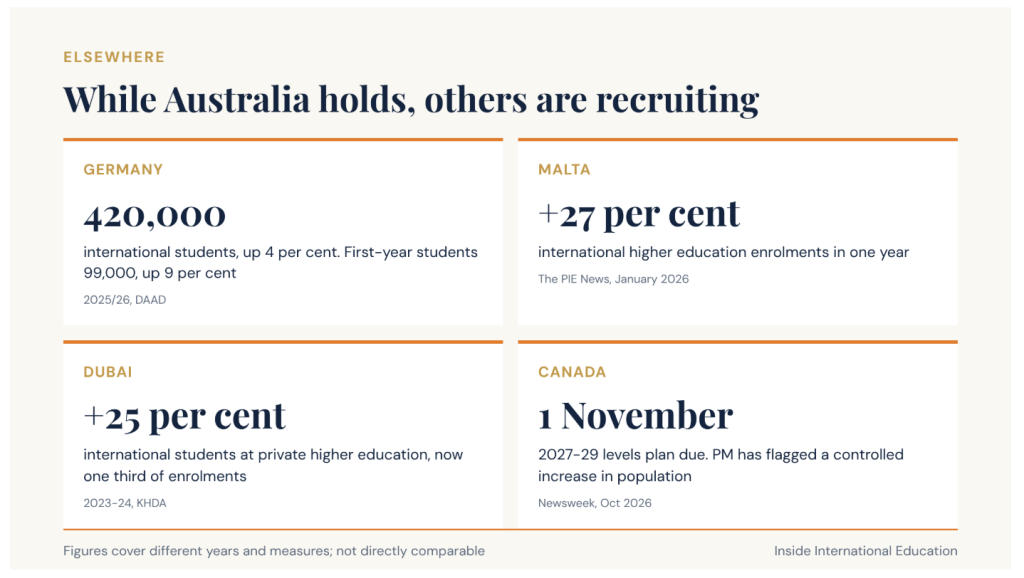
- The next Immigration Levels Plan must be tabled by 1 November 2026. Prime Minister Mark Carney has raised the prospect of a controlled increase in population after years of reductions.
- No student number has been confirmed. But if the plan lifts student arrivals, Canada comes back into the market for the same students Australia recruits.
Emerging destinations are growing
- Germany. About 420,000 international students in 2025/26, up 4 per cent. First-year international students reached 99,000, up 9 per cent, with master’s enrolments especially strong. Tuition-free public universities and English-taught programs do the selling.
- Malta. International higher education enrolments rose 27 per cent in one year. India showed the biggest increase, followed by Nigeria, Libya and Egypt. English-language study and post-study work options are the draw.
- United Arab Emirates. International students at Dubai’s private higher education institutions rose 25 per cent in 2023-24 and now make up a third of enrolments. Dubai has set a goal to become a leading global hub for higher education, and the UAE draws the majority of study destination searches in the Middle East and North Africa.
These markets are recruiting actively, often in the same source countries as Australia, with lower costs, simpler rules and post-study work on offer. When Australia makes the path harder, students do not stop studying abroad. They choose somewhere else.
My take
The planning level is a number the Government can hold steady while it changes everything around it. Allocations set how many students can start. The onshore rules, the transfer restriction and the working holiday changes decide who those students are, where they apply from and how long they stay.
And the students who do not come here now have more places to go than they did two years ago.
None of this shows in a single year of data. The sectors that sit at the start of the pipeline, English language and VET, will feel it first and loudest. Universities will feel it last, and by then the conversation will have moved on.
If you work with students at the start of their pathway, I would like to hear what you are seeing since 2 October. Fewer enquiries, different countries, more offshore applications?
Dates to watch
- Tuesday 27 October: Home Affairs at Senate Supplementary Budget Estimates.
- By 1 November: Canada tables its 2027-2029 Immigration Levels Plan.
- To be announced: start date for second and third-year working holiday ballots.
- 30 June 2027: 12-month transfer restriction ends.
- 1 July 2027: six-month restriction returns, and the student transfer visa stream starts.
Sources
- The PIE News: Overseas student commencements fall 5 per cent in Australian higher education
- Department of Education: Preliminary trends in higher education
- Study Australia: Australia confirms international education settings for 2027
- The PIE News: Most NOSCs stay flat as Australia releases 2027 provider numbers
- Home Affairs: Changes to Student visa application rules (500 and 590)
- Migration Alliance: National Code Amendment (Overseas Student Transfers) Instrument 2026
- Department of Education: Changes to the legislative framework for overseas students
- ICEF Monitor: New rules restricting agent commissions for onshore student transfers
- Information Age: Student visa crackdown puts migration agents on notice
- ABC News: What you need to know about the working holiday visa pause
- ABC News: Labor tightens visa rules as Tony Burke vows migration targets will be met
- The Daily Aus: Government to slash working holiday visa allocations
- Newsweek: Canada’s immigration plan could be about to change again
- Leap Digital: Canada’s international student cap, 2023-2027
- Maven Consulting: Canada study permit cap 2027
- ICEF Monitor: Germany’s foreign enrolments continued to grow in 2025/26
- The PIE News: Beyond the big four, the study destinations to watch in 2026
- Gulf News: Number of international students in Dubai surges by 25 per cent
- Parliament of Australia: Legal and Constitutional Affairs estimates program
General information only, not legal or migration advice. Figures are as published by the sources above and may be revised.
#InternationalEducation #InternationalStudents #StudentVisa #ELICOS #VET #HigherEducation #EducationAgents #Australia