
Inside International Education
Tuesday, 6 October 2026.
Last week set out what changed. This issue puts numbers on it: five years of history, then a forward view on net overseas migration, students, Working Holiday Makers and dependants.
The short version
- The Government forecasts NOM reduction to 245,000 for 2026-27 and 225,000 for 2027-28. That is a fall of 47,100 from the latest 292,100.
- Visa holders in the three affected programs (students, graduates, Working Holiday Makers) stood at about 1.03 million at 30 June 2025.
- My estimate: those holder numbers fall by about 155,000 to 178,000 (15 to 17 per cent) by 2028-29 if every measure commences and current trends hold.
- Estimated drop in annual spending at that point: A$4.6 billion to A$8.1 billion. Direct Government fee revenue probably rises, not falls, in the near term.
- Most dated figures come from Home Affairs and ABS. Forward figures are my model, with assumptions listed at the end.
1. Net overseas migration
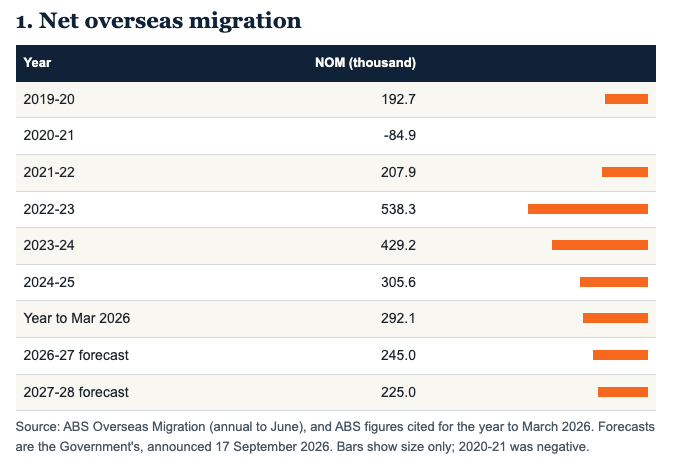
- 2022-23 to 2024-25: down 232,700 (minus 43 per cent).
- Year to March 2026 versus the year before: 292,100 against 309,500, down 17,400.
- 2026-27 target versus the latest figure: minus 47,100 (minus 16 per cent). 2027-28 target: minus 67,100 (minus 23 per cent).
- Against the 2022-23 peak the 2027-28 target is a fall of 58 per cent.
- Student arrivals were 157,000 in 2024-25 and student departures 48,600. Temporary visa holder arrivals were 363,000 and departures 148,000.
2. Student visas: lodged, granted, refused, onshore
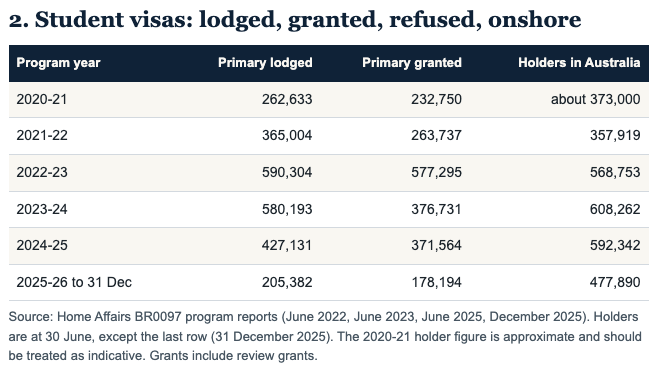
- Lodgements fell from 590,304 (2022-23) to 427,131 (2024-25): minus 28 per cent. Grants fell from 577,295 to 371,564: minus 36 per cent.
- The first half of 2025-26 versus the first half of 2024-25: lodgements up 0.8 per cent (205,382 against 203,835), grants down 3.5 per cent (178,194 against 184,684).
- Onshore holders at 31 December 2025: 477,890, down 8.5 per cent on 522,183 a year earlier. Peak at 30 June 2024: 608,262.
Refusals:
- 2024-25 program year: 18.1 per cent. Applied to 371,564 grants, that implies about 82,100 refusals (my derivation, not a published count).
- October to December 2025 quarter: about 19.3 per cent.
- June 2026: 24.2 per cent (ABC, from Home Affairs data). Higher education offshore reached 32.5 per cent in February 2026 (SBS).
- 2025-26 by citizenship: Nepal above 51 per cent, India above 40 per cent, China 5.8 per cent. Nepal reached 69 per cent in January to March 2026.
- Grant rate by sector, 2025-26 to 31 December: higher education 88.9 per cent, VET 51.8 per cent, ELICOS 29 per cent.
Full-year 2025-26 lodged, granted and holder figures are not yet published. Universities Australia says commencements are tracking 8 per cent below last year.
3. Working Holiday Makers: five years of growth
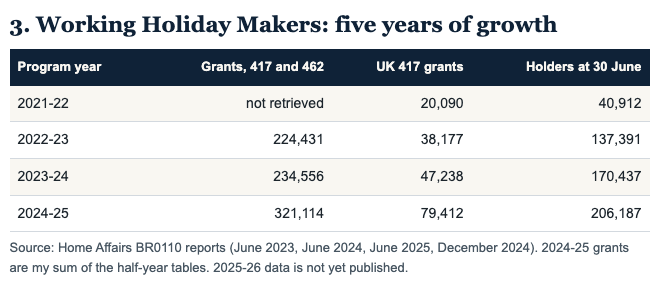
- Holders in Australia: 40,912 (June 2022) to 206,187 (June 2025). That is 5.0 times.
- UK 417 grants: 20,090 (2021-22) to 79,412 (2024-25). That is 4.0 times. Reporting puts the UK at around 17,000 when the trade agreement was signed.
- Total grants rose 37 per cent in 2024-25 (321,114 against 234,556).
- Second-year grants (417 and 462): 47,338 in 2023-24, then 90,754 in 2024-25. Third-year: 7,561, then 33,898.
- UK citizens took 28,606 of the second-year and 8,423 of the third-year grants in 2024-25 (30 per cent combined).
What the ballot does to onshore applications.
The announced ballot caps places at 45,000 (second year) and 5,000 (third year). Reporting says UK applicants are not subject to the same specified-work requirement, so I treat the UK as outside the ballot.
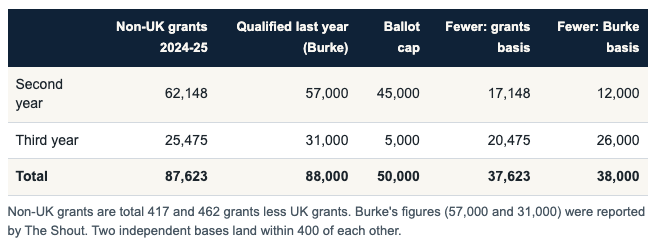
Non-UK grants are total 417 and 462 grants less UK grants. Burke’s figures (57,000 and 31,000) were reported by The Shout. Two independent reports are within 400 of each other.
- About 38,000 fewer second and third-year grants a year, with the third year hit hardest (down about 80 per cent on the non-UK 2024-25 level).
- Those who miss out have no onshore route to stay: students, graduates, visitors and Working Holiday holders can no longer apply for a Student visa in Australia (from 2 October 2026). Departures are expected in a short term due to limited timeframes for further applications (eg sponsorships).
- Steady-state effect on the Working Holiday holder stock: about 38,000 fewer, or 18 per cent of the 206,187 held at June 2025 (each second or third-year visa runs 12 months).
- Start date is not announced. Home Affairs says the package rolls out over 12 months.
4. Partners and children on Student (500) and Graduate (485) visas
- Family member visas granted to student visa holders last year: over 45,000 (as per Burke’s statement).
- Secondary holders on student and graduate visas: about 92,000 (June 2019), about 142,000 now. That is up 54 per cent.
- Graduate (485) holders at 30 June 2026: 271,191, of whom 73,897 (27 per cent) were secondary applicants.
- Studymove: dependant visas were about 10 per cent of higher education student visas granted in 2025-26.
- Offshore student dependant grants went mostly to Nepal, Bangladesh, Bhutan, India and Sri Lanka: 10,448 visas, over 70 per cent of the total. That puts offshore student dependant grants at no more than about 14,900 a year (my derivation). The rest of the 45,000 is onshore: subsequent entrants and graduate secondaries.
Exemptions cover Pacific and ASEAN passport holders, doctoral and some scholarship cohorts, and families already attached to a visa. China, India, Nepal, Bangladesh, Sri Lanka and Bhutan are not exempt. The exempt share of today’s 45,000 is unknown, so I run three cases.
Assumes an average stay of 2.5 years, and that families already in Australia are not removed, so the stock falls over two to three years. The 485 family restriction is announced; commencement of the 485 measure is not confirmed in the instruments reported to date.
5. Can the measures deliver the NOM target?
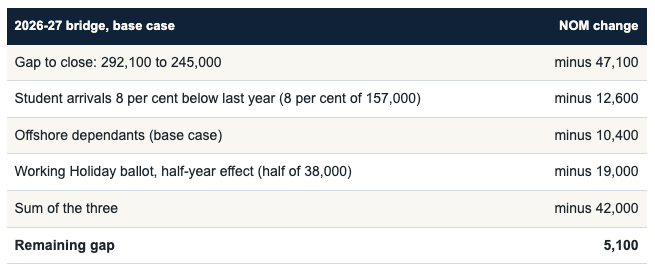
- With a full-year ballot effect and the high dependant case the sum is about 62,000, which overshoots the 47,100 needed.
- The range, 42,000 to 62,000, brackets the target. The target is achievable on paper. Timing is the risk: most measures have no start date.
- NOM counts people resident 12 of the last 16 months, so real effects lag. Treat this bridge as order of magnitude.
6. Overall decrease in temporary visa holders
Students and graduate holders at 30 June 2025: 592,342 and 228,909; Working Holiday: 206,187. Dependants overlap the student and graduate counts, so the total slightly overstates the combined change. The student line assumes the December 2025 trend holds.
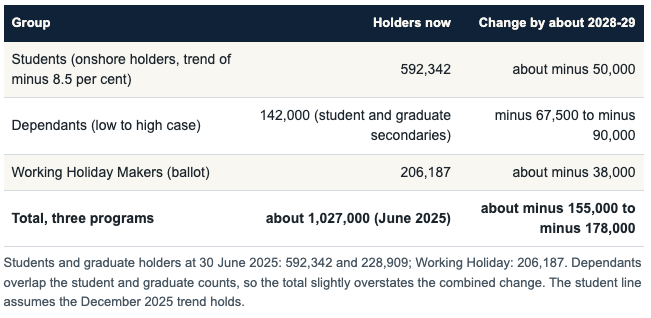
That is 15 to 17 per cent of the starting stock. Against the 2027-28 target, NOM would sit 67,100 below today.
7. Financial effect: the drop and the benefit
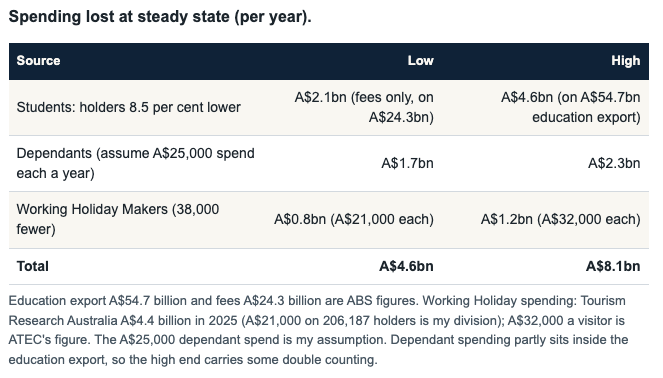
Education export A$54.7 billion and fees A$24.3 billion are ABS figures. Working Holiday spending: Tourism Research Australia A$4.4 billion in 2025 (A$21,000 on 206,187 holders is my division); A$32,000 a visitor is ATEC’s figure. The A$25,000 dependant spend is my assumption. Dependant spending partly sits inside the education export, so the high end carries some double counting.
- Scale: the A$54.7 billion education export supports about 250,000 jobs (Universities Australia, IEAA).
- Hospitality takes about one third of Working Holiday Makers. The sector recorded 40,600 vacancies in February 2026, the highest of any industry.
- Government visa charges move the other way. The Student visa charge rose from A$2,000 to A$2,500 on 1 July 2026. At 400,000 lodgements that is about A$1.0 billion a year, against A$0.8 billion at the old charge. An 8 per cent volume fall costs about A$80 million. Net, charges likely rise.
- Fewer second and third-year Working Holiday grants cost up to A$38 million in charges (38,000 at A$1,000), if the charge is paid only by those selected.
- The PBO costed the A$2,000 charge at A$764 million over four years, with small price elasticity (minus 0.01 for higher education to minus 0.1 for English courses). Volume is falling for other reasons: refusals, processing and the National Planning Level.
- Population benefit: 47,100 fewer net arrivals is 0.17 per cent of the 27.9 million population. The housing and services relief is real but I have not priced it.
Conclusion
- The Government has chosen process over a lower cap. The National Planning Level stays at 295,000 for 2027. Refusals, onshore lockouts, family limits and the ballot do the work.
- The measures are enough on paper to reach 245,000 in 2026-27. Delivery depends on start dates that do not yet exist.
- Holders in the three programs fall by roughly 155,000 to 178,000 by about 2028-29.
- Spending falls by roughly A$4.6 billion to A$8.1 billion a year at that point, concentrated in education, hospitality, regional tourism and inner-suburban rental markets. Government charge revenue is likely to hold or rise.
- Biggest uncertainties: the exempt share of dependants, whether the ballot starts before the 2027 peak season, and how many unsuccessful ballot entrants leave versus find another visa.
For agents and providers
- Onshore Student visa applications from temporary visa holders are now invalid. Check the holder’s current visa before lodging.
- Second-year Working Holiday clients who are not UK passport holders face a ballot. Discuss the work evidence and the fallback early.
- Refusal risk is concentrated by citizenship and sector. Genuine Student and financial capacity evidence carries the file.
- Family arrangements need a decision before the primary application, not after the grant.
Resources used
- Published figures: Home Affairs BR0097 and BR0110, ABS Overseas Migration, and the sources below.
- My derivations: 2024-25 refusal count, offshore dependant ceiling, non-UK ballot base, 2024-25 Working Holiday totals, all spending and holder scenarios.
- Assumptions: UK outside the ballot; 2.5-year average dependant stay; A$25,000 dependant spend; ballot effect phased over half a year in 2026-27.
- Not available: 2025-26 full-year program data, a published refusal count series, the legislative instrument for the ballot, and the 485 family commencement date.
- Two retrieved half-year tables carried inconsistent period labels; I used the totals Home Affairs states in its own executive summaries and checked the sums against them.
#InternationalEducation #StudentVisa #WorkingHoliday #NetOverseasMigration #AustralianImmigration #MigrationPolicy #HigherEducation #StudyInAustralia