
Inside International Education | Weekly
Jan Bejcek, Registered Migration Agent, MARN 0965239 | 10 October 2026
In 2025-26, Home Affairs granted 109,364 Student visas to primary applicants who lodged inside Australia. For 96,686 of them, the last visa held was another Student visa. A further 8,718 came straight from a Working Holiday visa.
Since 2 October 2026, most of those applications can no longer be made onshore.
This is the largest change to the Student visa (subclass 500) in years. It is law, not an announcement. It is governed by the Migration Amendment (Student Visa Reform) Regulations 2026, LIN 26/102 and LIN 26/087.
In today’s newsletter we dissect what it does, with worked examples and a checklist.
What changed on 2 October 2026
1. Seventeen visas now block an onshore application for a Student visa
A holder of any of these visas cannot make a valid Student or Student Guardian (subclass 590) application inside Australia. Stream and primary or secondary status make no difference for most of them.
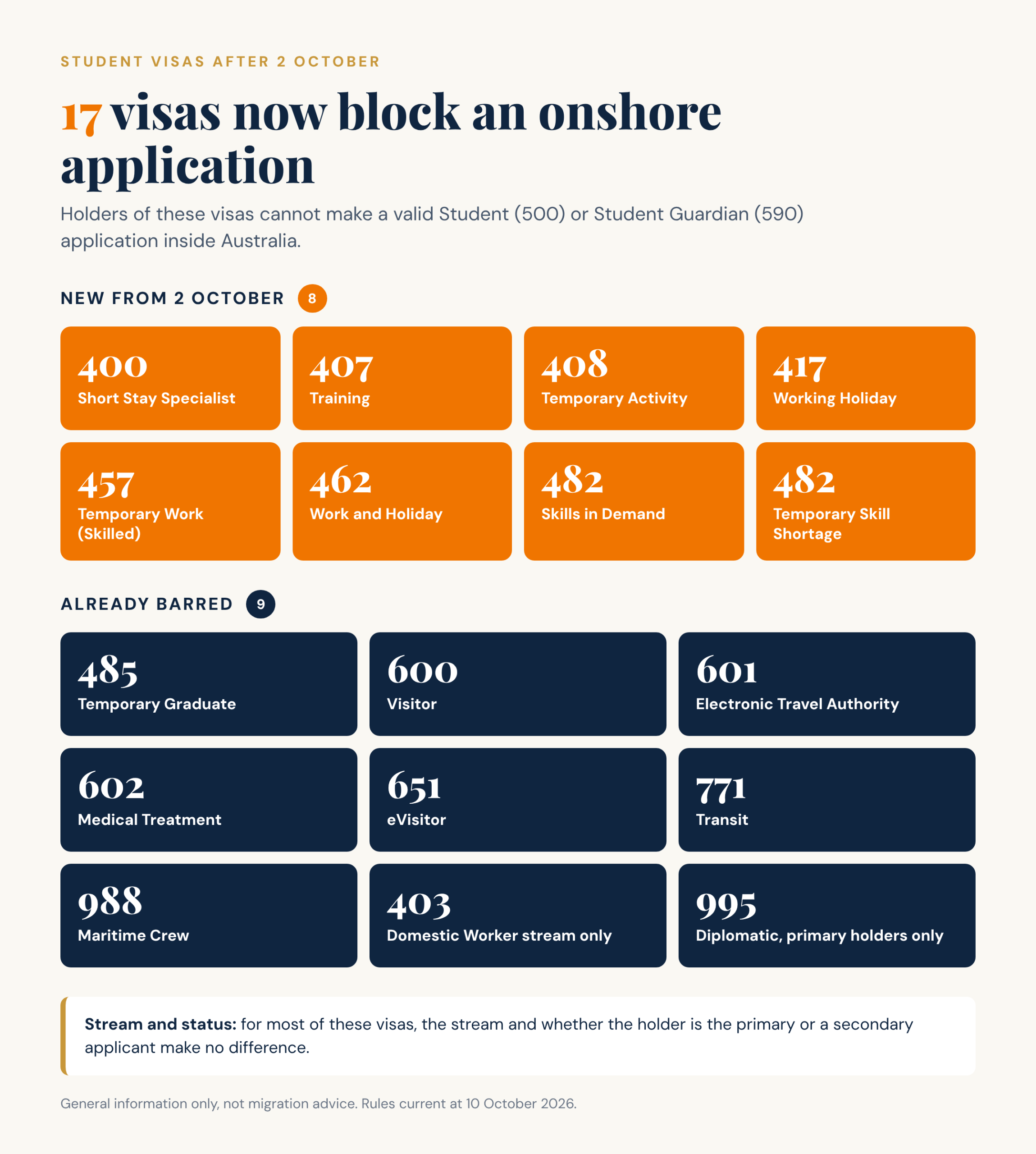
The real change is for working holiday makers and employer-sponsored workers. Until 1 October they could switch to a Student visa without leaving.
2. Current students to apply offshore by default
A primary Student visa holder can only lodge a further Student visa in Australia if one of six exemptions applies:
- Up to 12 more months, from the original end date of the main course, to finish it with the same provider.
- Sponsorship by DFAT or Defence.
- A doctoral degree. A Master’s by Research does not count.
- Primary or secondary school study.
- Progression to a higher-level course after completing the main course.
- Provider default.
Secondary (dependant) Student visa holders cannot use the exemptions to become the primary student onshore.
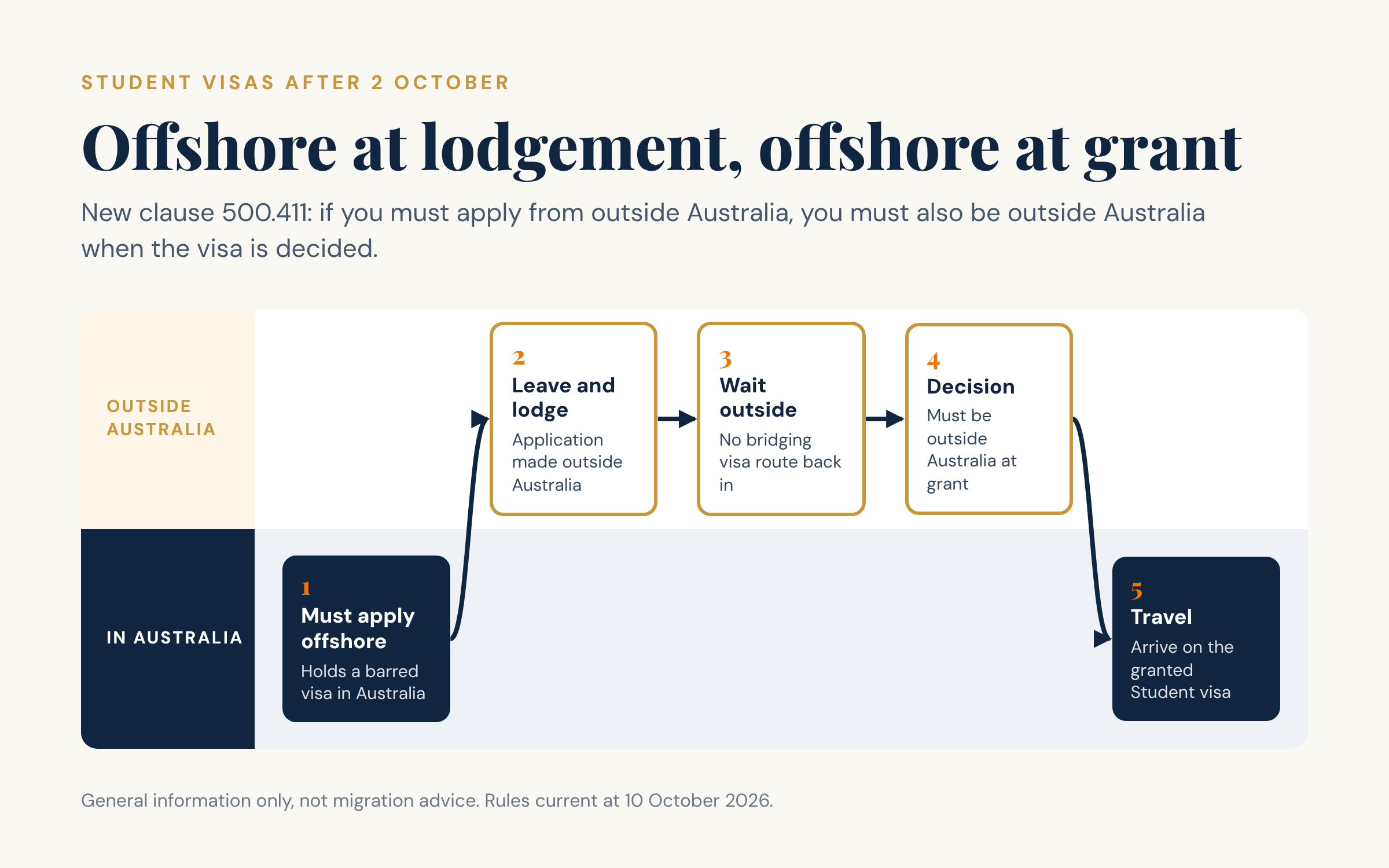
3. Offshore at lodgement and offshore at grant
New clause 500.411 closes the short-trip route. Before, a person required to apply offshore could leave briefly, lodge, return and wait on a bridging visa. Now they must also be outside Australia when the visa is decided.
4. The 28-day window is gone
A former student whose visa ended within the previous 28 days could still apply onshore. That provision has been repealed. A lapsed visa now means an offshore application, with a narrow carve-out for some ART cancellation decisions.
5. Progression must go up the AQF
Under LIN 26/087, the next course must sit at a higher AQF level than the completed one. If the completed course was higher education, the next one must also be higher education, delivered by a higher education provider. A second qualification at the same level is not progression.
6. Family members are mostly ineligible
New applicants generally cannot include a partner or children. Exemptions cover PhD students, DFAT or Defence sponsored students, foreign government scholarship holders and eligible Pacific and ASEAN students. No student can add family after grant. Subsequent entrants are no longer possible to add.
7. Provider transfers: 12 months, until 30 June 2027
A new provider generally cannot enrol a non-school student until they have completed 12 months of their principal course. It was six months. The rule reverts to six months from 1 July 2027. Limited exceptions apply, including a recorded release from the current provider.
8. One course closed to new overseas students
The BSB80120 Graduate Diploma of Management (Learning) has been specified for automatic suspension at VET providers. Students already enrolled can finish. Packages and pathways built around it need rethinking.
What did not change
- Core criteria: Genuine Student requirement, Confirmation of Enrolment, English, health insurance and financial capacity.
- Living costs: AUD 29,710 for 12 months for a primary student, on top of course fees and travel.
- Work: 48 hours per fortnight while the course is in session.
- Visa application charge: AUD 2,500 since 1 July 2026, up from AUD 2,000. Some passport holders and ELICOS applicants pay less.
- Processing priority: Ministerial Direction 115 still ranks offshore applications by provider progress against the 2026 National Planning Level of 295,000 new commencements.
That last point matters more now. More applications are being pushed offshore, and offshore is where provider priority affects processing time.
Worked examples
Example 1: Working holiday maker in Sydney
Tomas holds a 417 and wants to start a diploma in February. Before 2 October he could lodge onshore. Now he must lodge from outside Australia and stay outside until the decision. He needs to budget for flights, time abroad and a processing time that depends on his provider’s MD115 priority. His working holiday visa will not hold him in Australia while he waits.
Example 2: Bachelor to Master’s at a university
Priya completes a Bachelor degree (AQF 7) and enrols in a Master’s by coursework (AQF 9) at a university. Higher level, higher education to higher education. She can apply onshore, as she is exempt under the progression to higher-level provision.
Example 3: Bachelor to a VET course
Sam has completed a Bachelor of Engineering. His next course is a Certificate IV in Engineering Drafting at a VET college. This application goes offshore.
The same applies if Sam’s next course is a Graduate Diploma at a VET college. The AQF level is higher, but higher education must stay higher education. This one also goes offshore. The Department uses this exact scenario as an example.
Example 4: ELICOS to ELICOS
A student finishes a General English course and wants another English course. No AQF progression. Unfortunately, this application can only be made offshore.
Example 5: Needs one more semester
Ahmed failed two units and needs six extra months with the same provider. That is within 12 months of his original course end date. He can extend onshore. If he switches provider to finish, the exemption no longer fits.
Example 6: Partner joining later
Lin is granted a Student visa in November for a Master’s by coursework. Her husband planned to join in March as a subsequent entrant. That option no longer exists, and a coursework Master’s is not a family exemption. He needs a visa in his own right, or a different plan.
Example 7: Dependant who wants to study
Maria holds a Student visa as her partner’s dependant and wants her own course as the primary student. She cannot lodge onshore. Offshore application, offshore at grant.
Example 8: Lodged on 30 September
An application lodged before 2 October is assessed under the old rules, family members included. The protection attaches to the application, not the person. Withdraw it, or have it refused, and any new application falls under the new rules.
What to look for before lodging
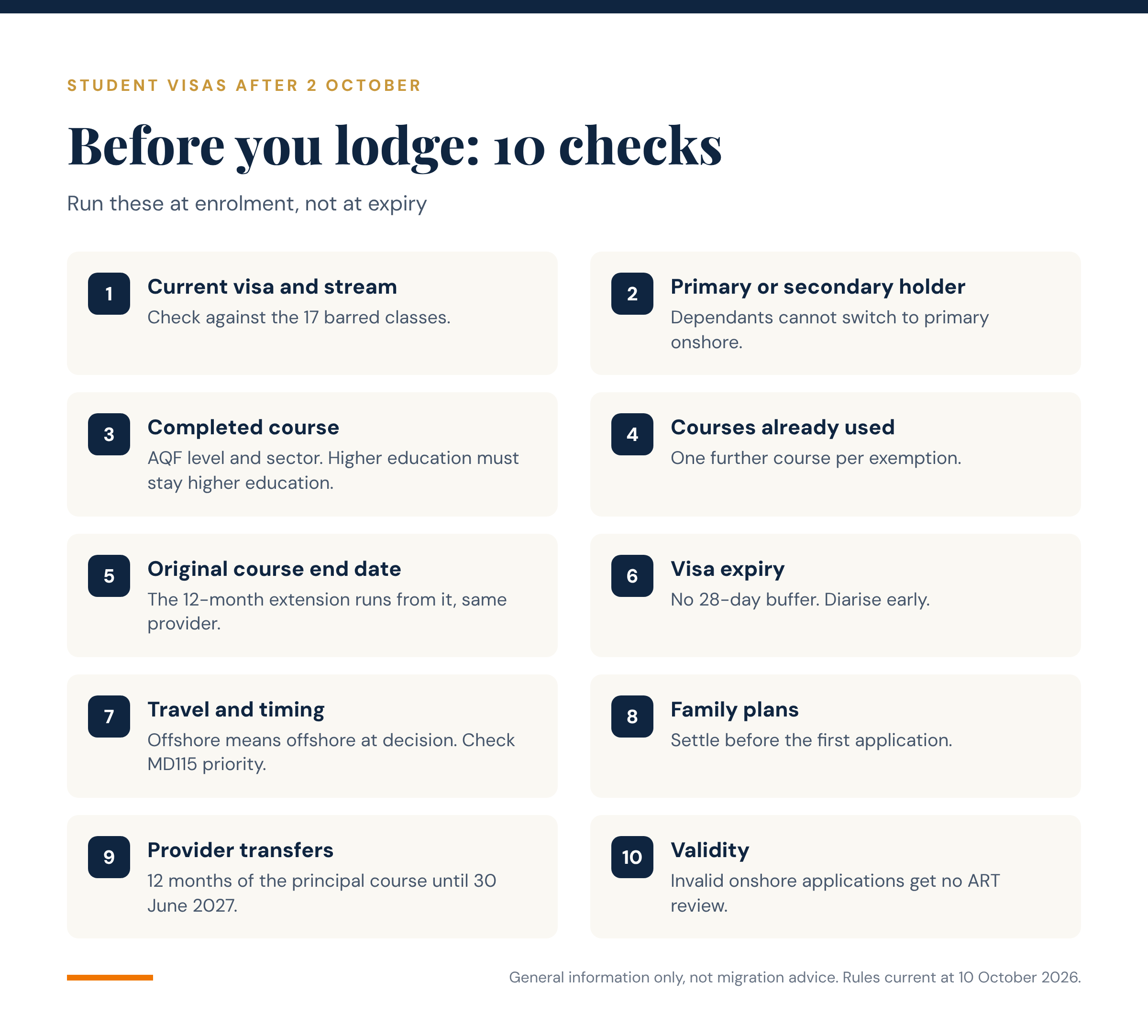
- Current visa and stream. Check it against the 17 barred classes before quoting an onshore pathway.
- Primary or secondary holder. Dependants cannot switch to primary onshore.
- Completed course: AQF level and sector. Higher education to VET fails, even at a higher level.
- Courses already used. One further course per exemption, outside school and provider default.
- Original course end date. The 12-month extension runs from that date, with the same provider.
- Visa expiry. There is no 28-day buffer any more. Diarise expiry dates early.
- Travel and timing. ‘Offshore’ means ‘offshore at decision’. Check the provider’s MD115 priority before setting a start date.
- Family plans. Settle them before the first application. Nobody can be added after grant.
- Provider transfers. 12 months of the principal course until 30 June 2027, unless a recorded release or other exception applies.
- Validity. An invalid onshore application cannot go to the ART for merits review. If the visa has expired, there may be no second chance.
- Pending applications. Lodged before 2 October? Review the application.
Important: Check ImmiAccount well before visa expiry
The law and the online system do not always move together. Test ImmiAccount before telling a client what can be lodged. For example, some students can still include family members already on their current visa in an onshore application. As at 10 October 2026, ImmiAccount will not let those family members be attached. Until the Department fixes this, an eligible application may not be possible to lodge as intended. Build that delay into timelines and visa expiry dates.
Announced, not law
- Student visa transfer stream: planned for 1 July 2027. Students changing provider would need the new visa before starting, at level or up the AQF. No regulations yet.
- Temporary Graduate family members: announced, with no instrument and no start date.
The bigger picture
The policy target is visa hopping. The practical effect is a shift of risk. Decisions that used to be fixed onshore with a fresh application now need to be right the first time: the course, the provider, the sequence and the family plan.
For agents and providers, the advice conversation moves earlier. The questions above belong at enrolment, not at expiry.
Which of these scenarios are you seeing most? Reply and tell me. The common ones will shape next week’s issue.
Sources: Migration Amendment (Student Visa Reform) Regulations 2026 (F2026L01347); LIN 26/102; LIN 26/087; Department of Home Affairs Student visa fact sheet and subclass 500 page; Home Affairs BP0015 Student visa granted report (2025-26, data to 31 August 2026); Ministerial Direction 115; Study Australia.
General information only, current at 10 October 2026. It is not migration advice. Check immi.homeaffairs.gov.au and get advice on individual circumstances before lodging.
#StudentVisa #InternationalEducation #AustralianImmigration #MigrationAgents #Subclass500 #StudyInAustralia #EducationAgents #VisaPolicy