
Inside International Education | 26 September 2026
On 17 September, Home Affairs Minister Tony Burke set out the migration changes the sector had been waiting on. It was announced that most new student and Temporary Graduate visa holders will no longer be able to bring family.
What was announced
- Secondary applicants restricted on most student and Temporary Graduate visas.
- Students who switch provider or course will need to apply for a new student visa, with exceptions for extenuating circumstances.
- Onshore continuation limited to students moving up the qualification ladder, for example bachelor to master.
- A “no further stay” condition on visitor visas.
- A ballot for years two and three of the Working Holiday Maker program, with a regional work requirement.
Who is exempt and who is protected
Exempt from the family restriction: PhD students, Pacific and ASEAN nationals, DFAT and Defence sponsored students, and foreign government scholarship recipients.
Families already attached to a visa stay as they are.
In numbers
- Between July 2025 and June 2026, Australia granted 337,400 student visas. About 46,000 were for dependants, roughly 14 per cent.
- South Asia accounted for more than 70 per cent of offshore dependant visas granted last financial year, according to Studymove.
- The government wants net overseas migration down from about 292,000 to 245,000 in 2026/27 and 225,000 in 2027/28.
The tension nobody has resolved
The government has held the 2027 student planning level at 295,000. It is also chasing a lower migration number.
Universities Australia says commencements are already down 8 per cent on last year. Policy commentator Abul Rizvi points out that a high refusal rate since November 2025 helped pull migration down. Delivering the planning level means refusals must fall.
His summary: “Something has to give.” The dependants rule may be one way to close that gap without touching the headline student number.
The frustration
This announcement did not land in a vacuum. Two other pressure points are still open:
- Work and Holiday visa (subclass 462) is still on hold. Applications from 24 countries have been paused since mid-August. There is no reopening date and no formal reason. The Minister has only said visas were being processed more slowly. Applicants cannot lodge, and the people advising them cannot plan.
- The Subclass 485 fee has more than doubled. The Temporary Graduate visa charge went from $2,300 to $4,600 on 1 March 2026, then to $5,750 on 1 July 2026. And now most new holders will not be able to bring their partners or children.
What to expect next
- Fewer applications for the 485.
- A paused working holiday stream.
- Student commencements down 8 per cent.
Three feeders into the Australian workforce are narrowing at the same time. Service industries such as hospitality and retail, and farm harvest work, all rely on students and working holiday makers. The Working Holiday Maker ballot for years two and three, with its regional work requirement, adds further uncertainty for farms.
This is an expectation, not a measured result. No commencement dates are confirmed, so the timing is again unknown and caught up in a political game.
One possible scenario for student visa numbers
This is an illustration, not a forecast. It starts from the last financial year: 337,400 student visas granted, of which 46,000 were for dependants and 291,400 for primary applicants.
It then applies assumed falls once the family restriction is fully in place. Two assumptions drive it. The first is how many dependant grants disappear after the exemptions for PhD, Pacific, ASEAN and sponsored students. The second is how many primary applicants choose another country because they cannot bring a partner.
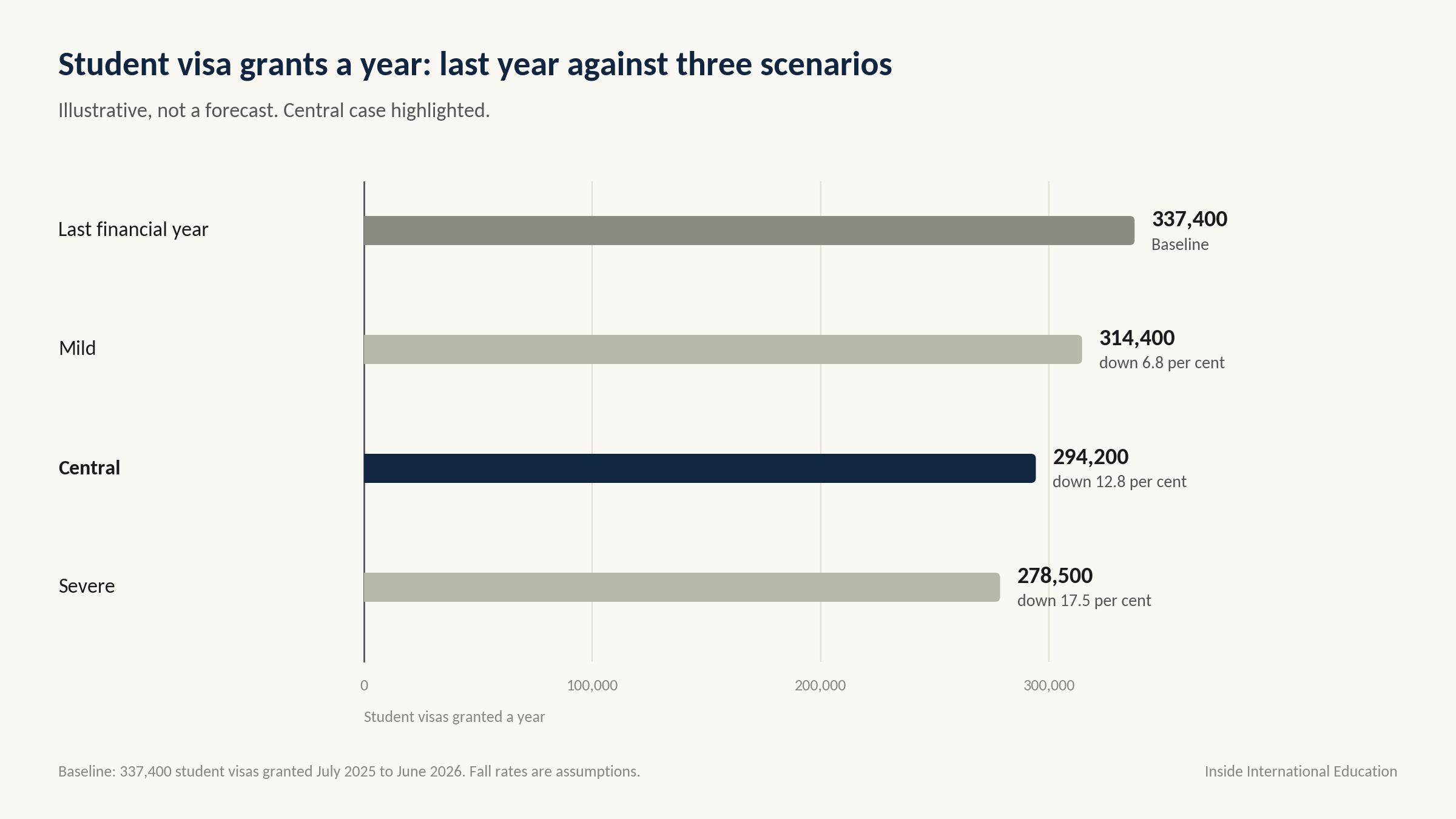
In the central case, around 34,500 dependant grants and 8,700 primary grants disappear. That is about 43,000 fewer people arriving each year.
Further, three more layers can reduce the numbers:
- The 485. With fewer students able to bring a partner, and a $5,750 fee, fewer graduates will lodge. The size of that fall is untested, so no number is offered here.
- Working holidays. If the subclass 462 pause continues, that whole stream is missing from the workforce count until it reopens.
- Timing. Unclear policy implementation and processing timeframes add another level of uncertainty and may deter further applicants.
What could the scenario cost in dollars?
This turns the same three cases into money. It is a rough model with round-number assumptions, not an economic forecast. Published export figures for international education are contested, so the inputs here are deliberately modest.
Assumptions
- Tuition: $33,000 a year for each primary student who does not come. This is a 2019 estimate.
- Living spend: $25,000 a year for each primary student and each dependant who does not come.
- Student visa charge: $2,500 for each primary applicant who does not apply.
- Dependant workers: 60 per cent of dependants are working-age partners, 70 per cent of them work, and they earn $28,000 a year.
(The scenario figures above are assumptions and should be verified. They are rough calculations for demonstration only.)
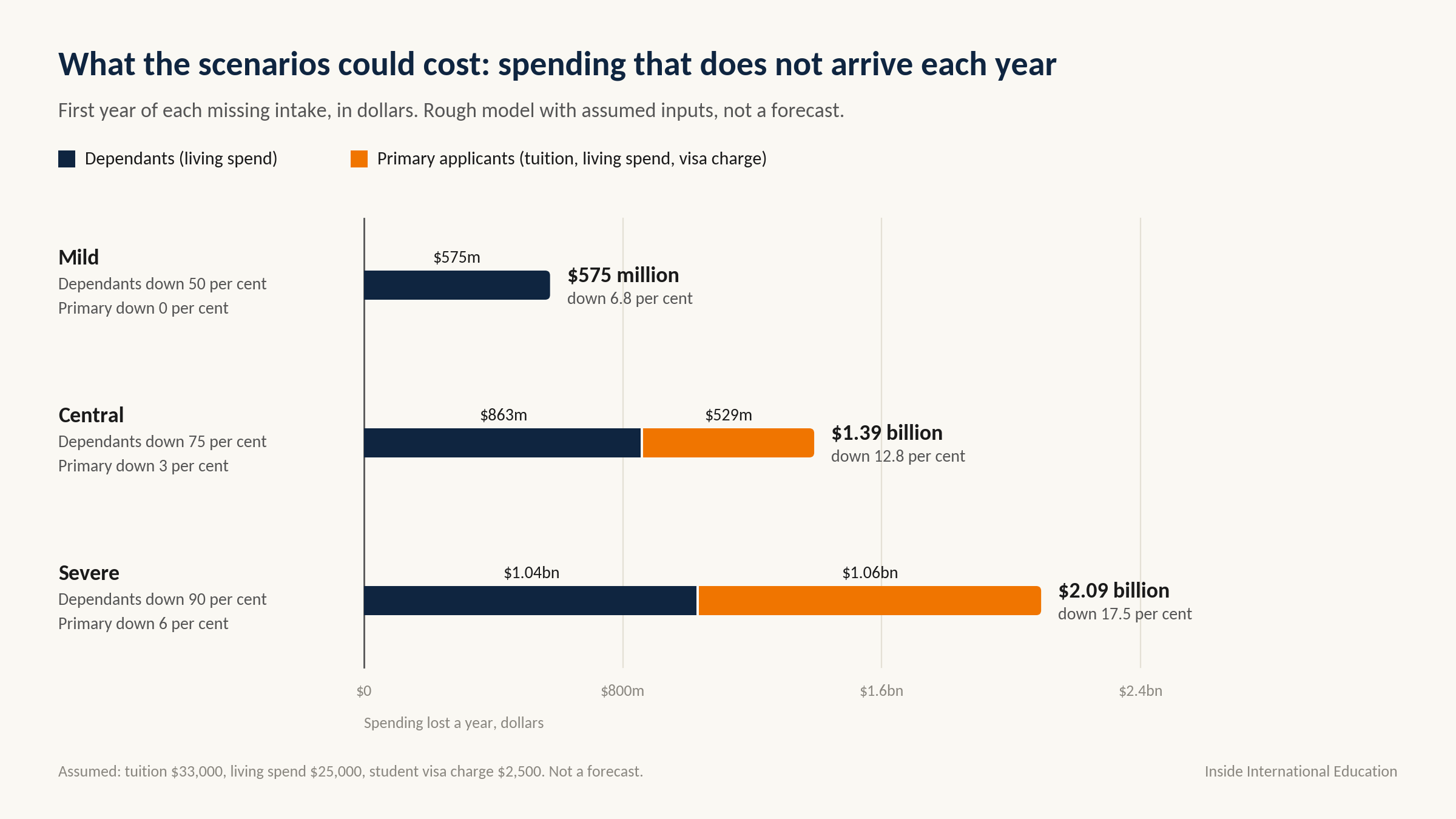
In the central case, about $1.4 billion of spending does not arrive in the first year of each missing intake.
- Length of stay multiplies it. A two-year course roughly doubles the standing annual loss once every intake is affected.
- Wages overlap with spending. In the central case, dependant workers would earn about $406 million, which is labour missing from cafes, kitchens, cleaning and farms. Do not add it to the total.
- Government visa revenue is the small part. The lost student visa charges are about $22 million in the central case. The larger loss lands on providers, landlords, retailers and employers.
- The living spend figure matters most. Every $5,000 change moves the central total by about $216 million.
- Not counted: 485 fee revenue, tax, working holiday makers, and students who still come but spend less.
The million-dollar question
- No commencement dates have been confirmed.
- No reopening date has been given for paused Work and Holiday visa applications.
- The full operating detail has not been published.
- Mr Burke told Question Time he would prefer legislation but will use other levers if he cannot get parliamentary support.
- It is unclear how the qualification ladder rule treats moves between courses at the same level.
Conclusion
The sector reaction is mixed. Most accept that visa hopping needs a fix. Many argue that the family bar will push genuine students towards other destinations. Both can be true.
The bottom line: the speech has been delivered, but the legislation and timeframe are lagging behind. It is still unclear when and how the changes will be implemented.
Sources:
- ICEF Monitor, 17 September 2026
- The PIE News, 23 September 2026
- ABC News, 18 August 2026 (working holiday pause)
- Hays Migration, Subclass 485 fee increase (1 March 2026)
- Australian Migration Lawyers, Subclass 485 fee (1 July 2026)
- IDP, student visa charge $2,500
- Fresh Economic Thinking, 2019 per-student spend estimate
- ABC News, 16 September 2026
Tags: #InternationalEducation #StudentVisa #AustralianMigration #MigrationPolicy #ELICOS #StudyInAustralia #NetOverseasMigration #MigrationAgents #WorkingHolidayVisa #Subclass485